

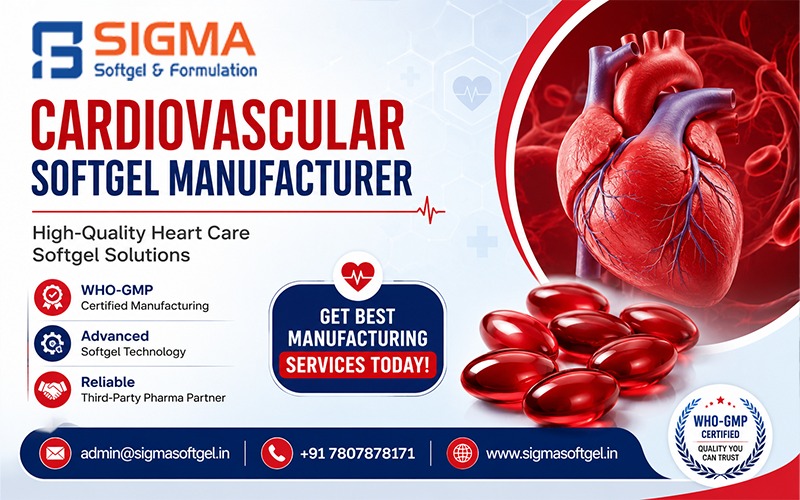
The global market for heart-health formulations is undergoing a dramatic shift. While classic consumers historically sought out single-ingredient options like standard fish oils, today’s wellness shoppers are highly educated, bio-analytically savvy, and demanding. They want high-potency, multi-active formulations that are free from unpleasant side effects like fishy reflux, rapid oxidation, or massive, dry pills that are difficult to swallow.
For brand owners, the most lucrative and clinically effective heart-health ingredients—such as Omega-3 polyunsaturated fatty acids (PUFAs), Coenzyme Q10 (CoQ10), Phytosterols, and Vitamin K2—are inherently lipophilic (fat-soluble) or liquid-based.
Attempting to compress these hydrophobic compounds into dry tablets or pack them into standard hard-shell capsules often leads to rapid active degradation, poor bioavailability, and leakage.
The softgel remains the undisputed gold standard for cardiovascular delivery systems. However, manufacturing a stable, leak-proof, and oxidation-free lipid capsule requires world-class pharmaceutical engineering.
This comprehensive guide breaks down the physical chemistry of cardioprotective lipid formulations, the advanced manufacturing processes required to protect delicate oils, and how to source the ideal production partner.
Why Softgels Dominate the Cardiovascular Supplement Sector
To build a compelling marketing strategy and justify your price point to retail buyers, you must understand the clinical and physical advantages of using a softgel delivery system for cardiovascular active ingredients.
1. Superior Bioavailability of Lipophilic Actives
Many of the most powerful cardiovascular raw materials are hydrophobic. Coenzyme Q10, for example, is highly crystalline and notoriously difficult for the human gastrointestinal tract to absorb in its native, dry state.
When formulated inside a softgel, CoQ10 can be pre-dissolved or suspended in a lipid carrier oil (such as organic flaxseed, extra virgin olive, or medium-chain triglyceride oil). This lipid matrix mimics the dietary fats required for optimal lymphatic absorption, significantly boosting the bioavailability of the active compound compared to dry, powder-filled capsules.
2. Hermetic Protection Against Oxidation
Cardiovascular oils—particularly marine-derived Omega-3s rich in eicosapentaenoic acid (EPA) and docosahexaenoic acid (DHA)—contain multiple double carbon bonds. This chemical structure makes them highly vulnerable to rancidity when exposed to oxygen, light, and ambient moisture.
Softgel encapsulation provides a completely hermetic (airtight) seal. The gelatin or plant-based polymer shell acts as a physical oxygen barrier, protecting the delicate oils inside from oxidation, preserving their therapeutic potency, and ensuring a stable shelf life of up to two years.
3. Effective Odor and Taste Masking
Consumer compliance is a major barrier to customer retention in the cardiovascular market. High-potency fish oils, garlic extracts, and krill oils possess strong, often repulsive natural odors and tastes.
Softgel technology completely seals these volatile organic compounds within the capsule shell. Advanced manufacturers can even formulate enteric-coated or gastric-resistant softgels that pass through the acidic environment of the stomach entirely intact, releasing their active payloads in the neutral pH of the upper intestine to completely eliminate the dreaded “fishy burp” reflux.
The Technical Challenges of Cardiovascular Softgel Production
Many brand owners underestimate the complexity of manufacturing a high-quality heart-health softgel. It is not a simple case of “pump-and-fill.” The physical chemistry of marine lipids and crystalline powders requires highly specialized processing equipment.
       [ Nitrogen Gas Purge ]  <-- (Protects unstable double bonds from air)
                 |
                 v
   [ Raw Marine/Plant Lipids ] ---> [ High-Shear Colloid Mill ] ---> [ Deaeration Vessel ]
                                               |                              |
                                      (Reduces CoQ10/Phytosterol     (Removes micro-bubbles
                                         crystals to sub-microns)     prior to encapsulation)
Managing the “Totox” (Total Oxidation) Value
The freshness of a cardiovascular oil is measured by its Peroxide Value (PV), Anisidine Value (AV), and the resulting Total Oxidation (Totox) value. High Totox values indicate that an oil has begun to decay, producing free radicals and a rancid taste that can damage cardiovascular health rather than support it.
To prevent oxidation during manufacturing, a premium facility must implement continuous nitrogen blanketing. This process involves purging all mixing tanks, holding vessels, and encapsulation hoppers with inert nitrogen gas to displace oxygen completely.
According to global voluntary standards maintained by the Global Organization for EPA and DHA Omega-3s (GOED), the maximum allowable Totox limit for high-quality marine oil is $26$. A top-tier manufacturer should consistently deliver finished products with Totox values well below this threshold.
Overcoming CoQ10 Recrystallization
CoQ10 is a solid, orange crystalline powder at room temperature. When mixed into a lipid carrier, the crystals have a natural tendency to precipitate out of the solution and cluster together over time. This recrystallization process reduces bioavailability and can create weak spots in the softgel shell, leading to physical deformation or leaking.
To solve this, advanced manufacturers utilize high-shear homogenization and precise thermal jackets to melt the crystalline structure of the CoQ10. It is then combined with specific solubilizing emulsifiers (such as non-GMO lecithin) to create a stable, non-recrystallizing suspension or a completely solubilized, crystal-free liquid matrix.
Formulating a Cutting-Edge Cardiovascular Portfolio
When designing your product briefs, avoiding basic “me-too” single-ingredient products is essential. Developing synergistic formulations allows you to command higher margins and target specific customer demographics, such as athletic performance, healthy aging, or prenatal care.
| Active Ingredient | Cardioprotective Mechanism | Formulating Challenge | Target Market |
|---|---|---|---|
| High-EPA Fish Oil | Supports healthy triglyceride levels and systemic inflammatory response. | High sensitivity to heat and oxygen; rapid degradation. | General adults, intensive cardiovascular support lines. |
| Coenzyme Q10 (Ubiquinone/Ubiquinol) | Powers cellular energy ($ATP$) production in cardiac tissue. | Highly crystalline structure; very poor native bioavailability. | Seniors, individuals taking statin medications. |
| Plant Phytosterols | Blocks the absorption of dietary cholesterol in the gut. | Extremely bulky powder requiring high doses ($800\text{ mg}$ to $1000\text{ mg}$). | Individuals managing cholesterol health. |
| Vitamin K2 (MK-7) | Directs calcium away from arterial walls and into the bones. | Chemically unstable when paired with certain calcium or magnesium salts. | Healthy aging, clean-label, bone-and-heart synergy. |
1. The Statin-Companion Formula: CoQ10 + Vitamin E
According to clinical reviews published by the National Institutes of Health (NIH) Coenzyme Q10 Fact Sheet, statin medications (which lower cholesterol) actively deplete the body’s natural reserves of CoQ10. This depletion can lead to muscle fatigue and oxidative stress.
A softgel combining $100\text{ mg}$ to $200\text{ mg}$ of highly bioavailable Ubiquinol (the active, reduced form of CoQ10) with natural d-alpha tocopherol (Vitamin E) is an incredibly high-margin, clinically relevant product that directly addresses this massive consumer demographic.
2. The Complete Lipid Complex: Omega-3 + Phytosterols + Garlic Oil
For consumers looking to manage overall cardiovascular profiles, combining marine lipids with plant sterols is highly effective. Phytosterols compete with cholesterol absorption in the small intestine.
Because phytosterols require a high daily serving size (typically around $800\text{ mg}$ of free plant sterols), your manufacturer must possess specialized high-speed encapsulation dies capable of handling dense, heavy suspensions without tearing the delicate gelatin ribbon.
3. Cardiovascular Softgel Manufacturer: Critical Vetting Criteria
Selecting your contract manufacturing partner is a multi-million dollar decision that determines your brand’s regulatory compliance, product efficacy, and long-term reputation. When searching for a premier 3. Cardiovascular Softgel Manufacturer to produce your heart-health line, prioritize the following operational and technological standards:
1. Marine Sourcing and Sustainability Certifications
Modern consumers demand ethical supply chains. If your cardiovascular formula contains fish oil, krill oil, or marine algal oil, your manufacturing partner must hold verified certifications from global sustainability bodies. Look for:
- Marine Stewardship Council (MSC): Guarantees that the marine resources are harvested sustainably from well-managed, traceable fisheries.
- Friend of the Sea (FOS): Verifies that the fishery minimizes environmental impact, protects non-target species, and maintains strict carbon footprint standards.
2. Advanced Molecular Distillation Capabilities
To guarantee that your finished softgel is free from environmental toxins, the raw oils must undergo rigorous purification. Marine sources can carry trace amounts of industrial pollutants, including polychlorinated biphenyls (PCBs), dioxins, and heavy metals like mercury and lead.
Ensure your manufacturer uses multi-stage molecular distillation. This high-vacuum, low-temperature process separates volatile contaminants from the beneficial EPA and DHA chains without exposing the heat-sensitive lipids to thermal degradation.
3. Comprehensive Analytical Testing (ICP-MS & HPLC)
Never rely solely on a raw material supplier’s Certificate of Analysis (COA). Your manufacturing partner must run an in-house, ISO-certified laboratory to verify every incoming raw material and outgoing finished batch.
Your contract manufacturer should utilize Inductively Coupled Plasma Mass Spectrometry (ICP-MS) for ultra-precise heavy metal analysis, and High-Performance Liquid Chromatography (HPLC) to guarantee that the active concentrations of CoQ10, Vitamin K2, or phytosterols exactly match your label claims throughout the product’s shelf life.
Enteric Coating vs. Gelatin Matrix: Optimizing Consumer Experience
To truly set your heart-health brand apart, pay close attention to the delivery technology of the softgel shell itself. Standard gelatin softgels dissolve rapidly in the highly acidic environment of the stomach, which can cause volatile marine oils to rise to the top of the gastric juices, resulting in an unpleasant reflux.
An experienced manufacturer can offer two primary solutions to solve this issue:
Enteric Coating (Post-Encapsulation)
After the softgels are encapsulated, dried, and polished, they are routed through a specialized pan-coating machine. A thin, food-grade enteric polymer layer is applied to the exterior of the shell. This coating is designed to remain intact at an acidic pH (under $3.5$), but dissolve rapidly in the neutral pH of the duodenum (pH above $5.5$).
Intrinsic Enteric Matrix
A cleaner, highly modern approach is the “enteric-in-the-shell” technology. Here, natural gastric-resistant polymers (such as sodium alginate or pectin) are mixed directly into the gelatin mass prior to encapsulation. This creates a softgel that is naturally gastric-resistant without requiring an extra coating step, resulting in a cleaner ingredient list and a beautiful, high-clarity finish.
To learn more about the physiological science behind targeted intestinal absorption and lipid digestion, you can explore the medical literature and research updates published by the American Heart Association (AHA).
Conclusion: Securing Your Brand’s Authority in Heart Health
Launching a premium heart-health supplement is a powerful way to build recurring revenue, high lifetime customer value, and genuine brand authority. However, because cardiovascular health is highly scrutinized by regulators and consumers alike, your formulation must be pristine, stable, and highly bioavailable.
By transitioning away from cheap, oxidized powders and partnering with a specialized cardiovascular softgel manufacturer, you ensure that your product contains clean, stable, and active compounds that deliver real cardiovascular support.
Ensure your chosen manufacturing partner uses nitrogen-blanketed mixing lines, high-shear homogenization for stable suspensions, and has the third-party certifications needed to back up your brand’s marketing claims. Taking these steps protects not only your brand’s financial investment, but also the long-term well-being of the consumers who trust you with their cardiovascular health.
 Home
Home Ask For Rate
 Call Us
 Whatsapp