

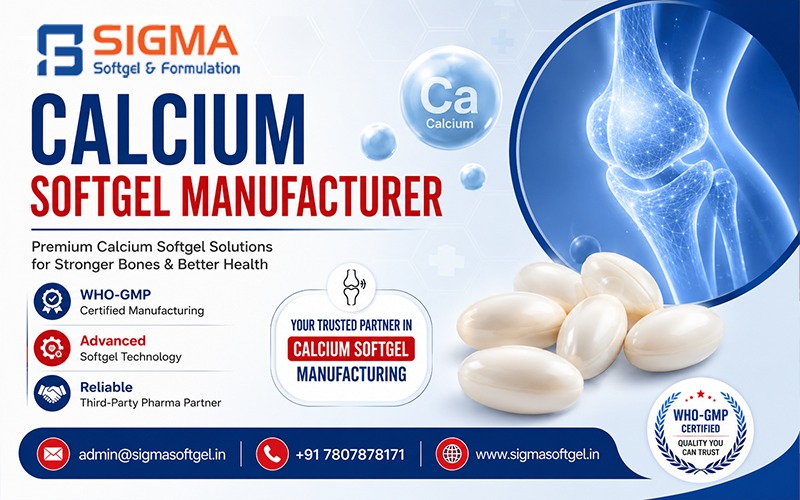
For decades, the calcium supplement market has suffered from a glaring consumer compliance problem: the “horse pill” dilemma.
Traditional calcium tablets are notoriously massive, chalky, dry, and incredibly difficult to swallow. Because calcium is a bulky mineral requiring high daily dosages (often between $1000\text{ mg}$ and $1200\text{ mg}$ for adults), dry-compressed tablets must be physically large to deliver therapeutic value. The result? Frustrated consumers, skipped doses, and abandoned bottles sitting in kitchen cabinets.
For modern supplement brands, this consumer pain point represents a massive market opportunity.
By transitioning from dry, chalky tablets to smooth, easy-to-swallow liquid softgels, brands can dramatically improve customer retention, brand loyalty, and overall product efficacy. However, encapsulating calcium into a stable, highly bioavailable softgel is one of the most complex challenges in contract manufacturing.
If you are looking to scale your wellness brand or formulate a next-generation bone health supplement, this guide will walk you through the technical science of liquid calcium formulations, what to look for in a specialized calcium softgel manufacturer, and how to bring a superior product to market.
The Softgel Advantage: Why Consumers and Brands are Ditiching Calcium Tablets
To build a successful marketing strategy around your new product, you must first understand the clinical and physical advantages that calcium softgels hold over old-school solid tablets.
1. Eliminating the “Chalky Pill” Fatigue
The physical experience of taking a supplement matters just as much as its nutritional profile. Softgel capsules are naturally lubricated by saliva upon contact with the mouth, making even larger doses glide easily down the esophagus. This sensory upgrade immediately sets your brand apart from competitors still selling rough, compressed calcium carbonate blocks.
2. Enhanced Disintegration and Rapid Release
Before the body can absorb calcium, the delivery vehicle must break down completely in the stomach. Compressed tablets rely heavily on binders and excipients that can sometimes fail to dissolve properly, especially in older adults with reduced stomach acid production.
A liquid-filled softgel, by contrast, ruptures rapidly in the gastric environment, releasing its pre-suspended calcium contents for immediate exposure to digestive enzymes and absorption sites.
3. Seamless Integration of Fat-Soluble Co-Factors
Calcium does not work in a vacuum. To be safely absorbed and deposited into the bone matrix rather than the arterial walls, calcium requires synergistic fat-soluble vitamins—specifically Vitamin D3 (cholecalciferol) and Vitamin K2 (menaquinone-7).
In a softgel, these hydrophobic vitamins can be effortlessly dissolved directly into the lipid carrier oil alongside the calcium suspension. This ensures a uniform, homogenous dose of all three active ingredients in every single capsule, something that is incredibly difficult to achieve consistently in dry powder blends.
The Technical Science of Calcium Softgel Manufacturing
Many brand owners assume that manufacturing a softgel is as simple as melting gelatin and pumping in liquid. In reality, producing a stable calcium softgel requires highly advanced pharmaceutical engineering.
If your contract manufacturer lacks specific experience in suspension science, your product line is highly vulnerable to failure. Here is a look behind the curtain at how a professional calcium softgel manufacturer handles this complex formulation.
The Physics of Liquid Suspensions
Unlike highly soluble vitamins, calcium is an insoluble, heavy mineral powder. It cannot be dissolved in the lipid oils (such as soybean, MCT, or flaxseed oil) used as the carrier inside a softgel shell. Instead, it must be formulated as a physical suspension—a liquid paste where solid calcium particles are evenly hung throughout the oil matrix.
If the suspension is not formulated correctly, two major issues occur:
- Sedimentation: The heavy calcium particles sink to the bottom of the mixing tanks before encapsulation, leading to massive dose variations between individual capsules.
- Syneresis: The oil and solid phases separate inside the finished softgel, causing the capsule to look visually unappealing, cloudy, or physically unstable.
To prevent this, a skilled manufacturer uses natural emulsifiers and suspending agents, such as non-GMO sunflower lecithin or yellow beeswax. These agents coat the calcium particles, keeping them uniformly suspended in a stable, thick, pumpable paste throughout the entire manufacturing run.
Micronization and Particle Size Reduction
The key to a smooth, non-gritty calcium suspension is micronization. Raw calcium powder often has a highly irregular, coarse particle size. If these large particles are pumped directly into the encapsulation machine, they can clog the precision injection wedges, scar the rotary dies, and create weak spots in the gelatin seam.
A top-tier manufacturer will route the calcium-oil mixture through an industrial colloid mill or high-shear homogenizer prior to encapsulation. This process grinds the calcium particles down to a sub-micron scale, ensuring a silky-smooth suspension that flows perfectly through the machinery and creates an ultra-durable, leak-proof capsule seal.
Sourcing the Right Calcium: Carbonate vs. Citrate vs. Plant-Derived
When designing your product brief, you must decide which form of calcium to use. Your choice will dictate the final capsule size, the active elemental dosage, and your brand’s marketing angle.
| Calcium Source | Elemental Calcium Content | Bioavailability Profile | Ideal Target Audience |
|---|---|---|---|
| Calcium Carbonate | High (Approx. $40\%$) | Requires stomach acid; best taken with food. | Budget-friendly, high-potency formulas. |
| Calcium Citrate | Lower (Approx. $21\%$) | Highly bioavailable; can be taken on an empty stomach. | Premium lines, seniors, individuals with low stomach acid. |
| Marine Algae (Algas calcareas) | Moderate (Approx. $30\%$) | Plant-based, highly bioavailable, rich in trace minerals. | Vegan, clean-label, eco-conscious consumers. |
1. Calcium Carbonate
This is the most common form of calcium used in dietary supplements due to its high density of elemental calcium ($40\%$). Because it contains more calcium per gram of raw material, you can achieve your target label claim using fewer or smaller softgels. This is the optimal choice for brands looking to offer a high-potency “one-to-two-capsule daily” serving size.
2. Calcium Citrate
While calcium citrate contains less elemental calcium ($21\%$), meaning consumers may need to take more capsules to reach their daily value, it is significantly easier on the digestive tract. It is absorbed equally well with or without food. According to clinical data compiled by the National Institutes of Health (NIH) Calcium Fact Sheet, calcium citrate is the preferred form for individuals with inflammatory bowel disease, gastric bypass history, or senior citizens with lower levels of gastric acid.
3. Plant-Based Marine Algae Calcium
For premium, organic, or vegan supplement lines, sourcing calcium derived from calcified red marine algae (such as Lithothamnion calcareum) is an incredible marketing differentiator. It provides naturally occurring trace minerals like magnesium and boron, which work synergistically to support bone density. If you choose this path, ensure your calcium softgel manufacturer has a verified supply chain for sustainably harvested marine materials.
Formulating for Synergistic Bone Health: The D3 + K2 Triad
If your brand wants to stand out in a crowded marketplace, avoid launching a standalone calcium supplement. Modern consumers are highly educated and actively seek out complete, scientifically backed formulations.
To maximize bone absorption and prevent health risks, your formulation should include the following co-factors:
Vitamin D3 (Cholecalciferol)
Without Vitamin D3, the human body cannot efficiently absorb calcium from the gut. Vitamin D3 acts as the biological key that unlocks the active transport proteins in the intestinal wall, allowing calcium ions ($Ca^{2+}$) to enter the bloodstream.
Vitamin K2 (specifically Menaquinone-7 or MK-7)
While Vitamin D3 gets calcium into the blood, Vitamin K2 acts as the traffic controller. It activates a protein called osteocalcin, which binds calcium directly to the bone matrix. Simultaneously, it activates matrix Gla protein (MGP), which helps prevent calcium from depositing in the arteries and kidneys.
To learn more about how these nutrients work in tandem to prevent arterial calcification, you can explore the comprehensive cardiovascular and bone health studies published by the Harvard T.H. Chan School of Public Health.
By partnering with an R&D-focused contract manufacturer, you can easily formulate a highly marketable “Calcium + D3 + K2” liquid softgel suspension using clean-label carrier oils like extra virgin olive oil or organic coconut-derived MCT oil.
             [ Ingested Calcium Softgel ]
                         |
                         v (Stomach Acid Breaks Shell)
             [ Liquid Calcium Released ]
                         |
                         + <--- [ Vitamin D3 Promotes Gut Absorption ]
                         |
                         v
             [ Calcium Enters Bloodstream ]
                         |
                         + <--- [ Vitamin K2 Directs to Bone Matrix ]
                         |
                         v
            [ Healthy, Dense Bone Mineralization ]
            (Safely avoiding arterial calcification)
Quality Indicators to Evaluate in a Calcium Softgel Manufacturer
Choosing a contract manufacturing partner is a multi-million dollar decision that directly impacts your brand’s reputation. When vetting potential facilities, look beyond basic price sheets and thoroughly evaluate their operational standards.
1. Robust cGMP Compliance and Certifications
The facility must be fully compliant with the FDA’s Current Good Manufacturing Practice (cGMP) regulations (21 CFR Part 111). Additionally, look for facilities that hold premium, independent third-party audits and certifications from recognized global bodies, such as:
- NSF International (or NSF for Sport for athletic supplement brands)
- SGS or UL Solutions
- Halal and Kosher Certifications (if targeting dietary-restricted consumer bases)
2. Specialized Nitrogen Flushing Capabilities
Lipid carrier oils and fat-soluble vitamins (like D3 and K2) are highly sensitive to oxygen. Exposure to air during the mixing and encapsulation processes can trigger rapid oxidation, leading to rancid smells, altered colors, and degraded vitamin potencies.
Ensure your manufacturer utilizes closed-loop mixing tanks that are continuously blanketed with inert nitrogen gas to shield the active fill material from oxidation from the moment of raw material blending to the final capsule seal.
3. Rigorous Heavy Metal and Purity Testing
Because calcium is a mined mineral, it carries a natural risk of contamination with heavy metals, including lead, arsenic, cadmium, and mercury. This is particularly critical if you are selling products in states with strict environmental laws, such as California’s Proposition 65.
Your manufacturer must perform strict Inductively Coupled Plasma Mass Spectrometry (ICP-MS) testing on every incoming batch of raw calcium to guarantee absolute purity before it ever reaches the production floor.
Conclusion: Partnering for Sustainable Brand Growth
The transition from outdated, hard-to-swallow calcium tablets to premium, highly bioavailable liquid softgels is one of the smartest upgrades you can make for your supplement portfolio. By focusing on consumer-centric design—easy swallowability, rapid absorption, and synergistic formulations featuring Vitamins D3 and K2—you place your brand at the absolute forefront of the modern bone health category.
Success in this specialized niche requires more than just great marketing; it demands the technical expertise of a seasoned calcium softgel manufacturer capable of handling complex physical suspensions, micronizing raw mineral materials, and executing flawless, leak-proof encapsulation.
Take your time vetting your manufacturing partners, demand strict cGMP transparency, and craft a clean-label formula that delivers real, touchable health results for your customers. Your brand’s long-term authority and customer retention depend entirely on the quality of the capsule you deliver.



 Home
Home Ask For Rate
 Call Us
 Whatsapp