

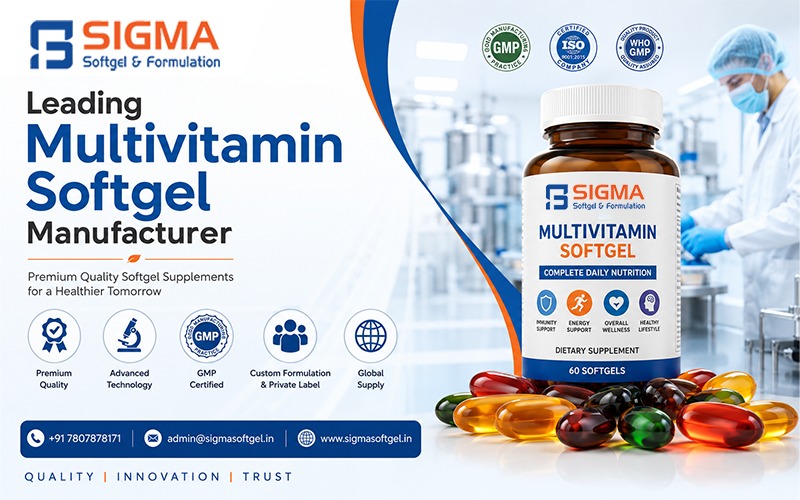
The dietary supplement landscape is experiencing a significant shift in consumer preferences. The era of the giant, dry, compressed multivitamin tablet is quickly drawing to a close. Today’s wellness consumers are actively avoiding “pill fatigue” and demanding highly bioavailable, premium delivery formats that fit seamlessly into their daily routines.
For brand owners, meeting this demand requires a transition to liquid-filled capsules. However, enclosing a broad spectrum of vitamins, minerals, and functional botanical extracts into a single, stable lipid capsule is an incredibly complex task. It requires deep chemical expertise, precise machinery, and an advanced manufacturing partner.
Whether you are looking to launch a prenatal complex, a daily active formula, or a healthy-aging product, this guide explores the physical chemistry, formulation challenges, and critical standards you must require from your multivitamin softgel manufacturer.
Why Softgels Are the Ultimate Delivery System for Multivitamins
When pitching your product to retail buyers or educating your direct-to-consumer (DTC) audience, you must clearly articulate the physical and metabolic advantages of the softgel format over traditional tablets or hard-shell capsules.
1. Enhanced Bioavailability of Fat-Soluble Actives
A standard daily multivitamin contains a mix of both water-soluble and fat-soluble nutrients. Fat-soluble vitamins—specifically Vitamin A, Vitamin D3, Vitamin E, and Vitamin K2—require a lipid environment to trigger the bile secretions necessary for micelle formation and lymphatic absorption in the small intestine.
In dry tablets, these lipophilic compounds are often poorly absorbed, especially if the consumer takes them on an empty stomach. A softgel pre-dissolves these fat-soluble actives in a premium carrier oil (such as organic coconut oil, sunflower seed oil, or medium-chain triglycerides), significantly boosting their bioavailability.
2. Multi-Phase Suspension Loading
A premium multivitamin is rarely just vitamins. Modern formulations often integrate botanical extracts (such as lutein or ginseng), amino acids, and essential trace minerals.
An advanced softgel shell can house a highly complex, dense suspension (a liquid matrix containing evenly distributed micronized solids). This allows brand owners to deliver a diverse, multi-active ingredient list in a single, easy-to-swallow dose that would otherwise require multiple dry pills.
The Physical Chemistry: Formulating a Stable Multivitamin Suspension
Many brand owners assume that manufacturing a multivitamin softgel is as simple as mixing powders with oil and pumping them into a gelatin shell. In reality, liquid multivitamin formulations are highly complex chemical environments.
To create a stable product, a premium manufacturer must actively manage and overcome several technical challenges.
          [ Raw Liquid Oils ]         [ Micronized Dry Minerals ]
                   \                      /
                    v                    v
              [ High-Shear Mixing & Homogenization ]
                                 |
                                 v
                     [ Nitrogen Deaeration ]
                                 |
              (Prevents oxidation of sensitive actives)
                                 |
                                 v
                  [ Rotary Die Encapsulation ]
1. Preventing Sedimentation and Syneresis
In a multivitamin “slurry,” dense mineral powders (such as zinc oxide, calcium carbonate, and magnesium oxide) are suspended in a lighter lipid vehicle. Gravity naturally forces these heavier particles to settle to the bottom of the capsule over time—a process known as sedimentation. If the suspension is poorly formulated, it can also lead to syneresis, where the liquid carrier separates from the solid particles.
To prevent this, your manufacturing partner must utilize specialized high-shear colloid mills and homogenizers. These machines reduce the particle size of the dry minerals to sub-micron levels (micronization) and blend them with food-grade suspending agents (such as yellow beeswax or non-GMO soy lecithin) to create an incredibly stable, high-viscosity suspension that remains completely uniform throughout its shelf life.
2. Managing Active Ingredient Interactions
Vitamins and minerals are chemically active compounds that can interact destructively when placed in close proximity. For instance, trace minerals like divalent copper ($Cu^{2+}$) and iron ($Fe^{2+}$) act as powerful catalysts for the oxidation of lipid-soluble vitamins, particularly Vitamin A and Vitamin D3.
To prevent these internal reactions, a sophisticated multivitamin softgel manufacturer will utilize micro-encapsulation technologies. By coating reactive mineral particles in a micro-thin, protective food-grade ethylcellulose or lipid barrier prior to suspension, they prevent direct contact between the incompatible actives, preserving the potency of the entire formula.
3. Oxygen and Moisture Control
Water-soluble vitamins, especially Vitamin C (ascorbic acid) and B-vitamins like Thiamine ($B_1$) and Cobalamin ($B_{12}$), are highly hygroscopic (they attract water) and sensitive to ambient oxygen. If exposed to moisture during the manufacturing process, Vitamin C will rapidly oxidize, turning the inner fill paste a dark, unappealing brown.
Premium facilities control this by:
- Maintaining strict climate-controlled environments with Relative Humidity (RH) levels consistently below $30\%$.
- Employing nitrogen gas blanketing over all raw ingredient mixing tanks and encapsulation hoppers to completely displace oxygen.
- Utilizing advanced stability chambers to test finished batches under accelerated conditions (e.g., $40^\circ\text{C}$ and $75\%$ RH) to ensure the product remains stable in various global climates.
Technical Comparison: Gelatin vs. Plant-Based Softgel Shells
When designing your product, one of the most important decisions is choosing the composition of the softgel shell. Modern consumers are increasingly seeking clean-label and vegetarian options.
| Shell Characteristic | Animal-Based Gelatin | Vegan/Plant-Based Matrix |
|---|---|---|
| Primary Material | Bovine or Porcine Gelatin (collagen-derived) | Modified Corn Starch, Carrageenan, Glycerol, and Water |
| Thermal Stability | Lower (susceptible to cross-linking at high temperatures) | Higher (withstands higher storage and shipping temperatures) |
| Oxygen Permeability | Low (excellent protection for oxygen-sensitive actives) | Slightly higher (requires optimized outer packaging/desiccants) |
| Consumer Appeal | Traditional, cost-effective | Premium, clean-label, $100\%$ Halal, Kosher, and Vegan |
| Manufacturing Speed | High encapsulation efficiency and faster ribbon drying | Requires specialized, slower rotary die adjustments |
5 Critical Questions to Vet a Multivitamin Softgel Manufacturer
Choosing a contract manufacturing partner is a major decision that directly impacts your brand’s regulatory compliance, product quality, and financial success. When interviewing a potential multivitamin softgel manufacturer, use these key technical questions to evaluate their capabilities:
1. What are your in-house analytical testing capabilities?
A reputable manufacturer should never rely solely on raw material suppliers’ Certificates of Analysis (COAs). They should operate an ISO/IEC 17025 certified in-house laboratory equipped with:
- High-Performance Liquid Chromatography (HPLC): To precisely quantify the active levels of delicate vitamins, such as Methylcobalamin ($B_{12}$) and Pyridoxine ($B_6$), ensuring your product meets label claims.
- Inductively Coupled Plasma Mass Spectrometry (ICP-MS): This is the gold standard for heavy metal testing. It can detect trace levels of lead ($Pb$), arsenic ($As$), cadmium ($Cd$), and mercury ($Hg$) down to parts-per-billion (ppb) levels.
2. How do you prevent cross-contamination?
Because multivitamin manufacturing involves handling a wide variety of powders, oils, and allergens (like soy or fish-derived omega carriers), strict cross-contamination protocols are essential. The manufacturer should adhere to the FDA’s Current Good Manufacturing Practice (cGMP) Regulations, featuring dedicated air-handling systems (HVAC) with HEPA filtration and validated cleaning procedures between production runs.
3. What is your minimum order quantity (MOQ) and scale-up capacity?
Softgel encapsulation is a continuous, high-speed process. Because of the initial setup times, gelatin ribbon waste, and clean-in-place (CIP) cycles, MOQs for softgels are generally higher than for tablets or hard-shell capsules.
- A typical starting MOQ for a custom multivitamin softgel is around $300,000$ to $500,000$ capsules.
- Ensure your partner has the capacity to scale with you, moving from pilot-scale encapsulation machines to high-output rotary die lines capable of producing millions of capsules per day.
4. How do you verify shell-fill compatibility?
The active ingredients in a multivitamin suspension can sometimes interact with the softgel shell itself. For example, certain highly hydrophilic compounds can pull water out of the gelatin shell, making it brittle and prone to cracking. Conversely, other compounds can migrate into the shell, causing it to become sticky or leak.
Your manufacturer should conduct proactive compatibility and dissolution testing in accordance with the United States Pharmacopeia (USP) guidelines to guarantee that your product will not leak or degrade during storage.
5. Do you hold recognized third-party quality certifications?
To build trust with major retailers and consumers, your manufacturer’s facility should hold active certifications from recognized global organizations. Look for partners with:
- NSF International GMP Registration: Proves the facility is audited regularly for strict compliance with dietary supplement manufacturing standards.
- UL/NPA (Natural Products Association) Certification: Further verifies compliance with high-quality industry standards.
- To learn more about the evolving regulatory landscape and best practices for dietary supplement safety, you can consult resources from the Council for Responsible Nutrition (CRN).
Conclusion: Partnering for Long-Term Brand Success
Launching a successful multivitamin softgel requires balancing biological efficacy with advanced physical chemistry. By transitioning away from standard, dry tablets and embracing bioavailable softgels, you position your brand as a premium leader in the health and wellness market.
However, because multivitamins are highly complex, multi-ingredient formulations, your choice of a contract production partner is critical. By choosing a specialized multivitamin softgel manufacturer that implements high-shear homogenization, strict moisture controls, and robust analytical testing, you protect both your brand’s financial investment and the long-term health of the consumers who trust your products.


 Home
Home Ask For Rate
 Call Us
 Whatsapp