

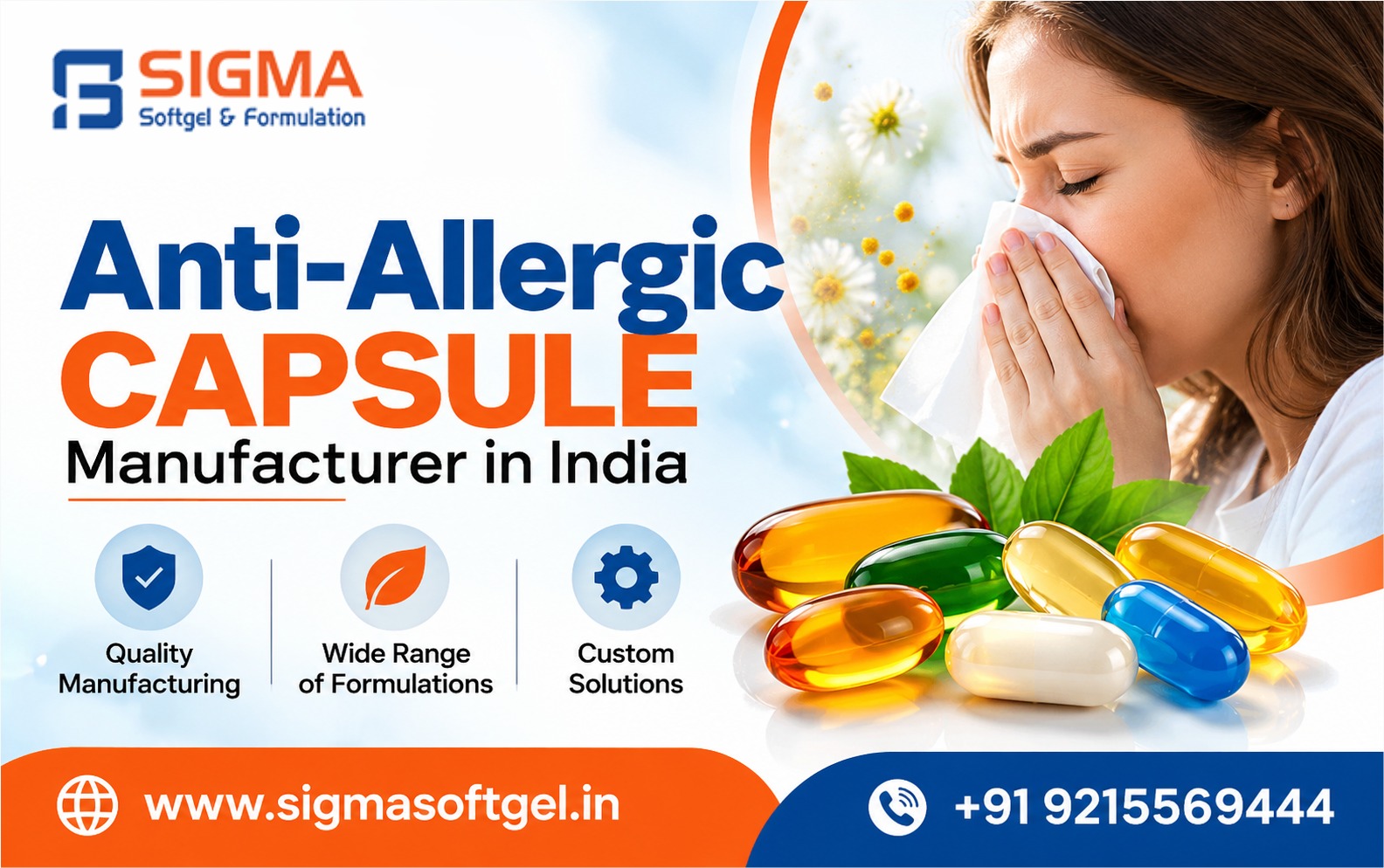
Allergic conditions are common health concerns that can affect people across different age groups. As demand for dependable allergy-management products continues to grow, pharmaceutical companies and healthcare brands increasingly look for experienced manufacturing partners that can provide consistent quality, suitable formulations, and reliable production support.Choosing the right Anti-Allergic CAPSULE Manufacturer India is therefore an important business decision. A capable manufacturing partner can support product development, raw-material sourcing, capsule production, quality testing, packaging, and documentation while helping brands maintain consistent product standards.
For businesses searching for experienced Softgel manufacturesrs in india, Sigma Softgel provides manufacturing-focused solutions for brands seeking dependable softgel and pharmaceutical production support.
What Are Anti-Allergic Capsules?
Anti-allergic capsules are oral pharmaceutical formulations developed to support the management of allergic conditions. Depending on the approved formulation and active ingredient, such products may be used for symptoms associated with conditions such as allergic rhinitis, skin allergies, itching, sneezing, watery eyes, or other allergic manifestations.
The exact therapeutic purpose depends on the active pharmaceutical ingredient, dosage strength, formulation, and regulatory classification of the product. Therefore, manufacturers must follow applicable pharmaceutical manufacturing and quality requirements rather than treating every anti-allergic capsule as the same type of product.
A professional Anti-Allergic CAPSULE Manufacturer India should understand the importance of formulation accuracy, controlled production processes, appropriate packaging, and quality testing.
Why Choose an Anti-Allergic CAPSULE Manufacturer in India?
India has developed a substantial pharmaceutical manufacturing ecosystem with manufacturers supplying medicines and healthcare products to domestic and international markets.
For pharmaceutical marketers, distributors, healthcare companies, and established brands, working with an Indian manufacturer can provide access to manufacturing capabilities, formulation expertise, production infrastructure, and supply-chain networks.
Some important reasons companies consider Indian manufacturing partners include:
- Established pharmaceutical manufacturing infrastructure
- Availability of pharmaceutical raw materials and packaging suppliers
- Experienced technical and quality-control professionals
- Flexible manufacturing arrangements
- Support for private-label and third-party manufacturing
- Product development and formulation assistance
- Batch-wise quality-control procedures
- Domestic and export-oriented manufacturing capabilities
However, manufacturers should be evaluated individually. A company should review its manufacturing capabilities, regulatory documentation, quality systems, product portfolio, and ability to meet the specific requirements of the proposed product.
Role of a Professional Anti-Allergic Capsule Manufacturer
A pharmaceutical manufacturer does more than simply fill capsules. The manufacturing process can involve several controlled stages, starting with formulation planning and material procurement and continuing through production, testing, packaging, and release.
A professional Anti-Allergic CAPSULE Manufacturer India may provide support across areas such as:
1. Product Formulation
Formulation is one of the most important stages in pharmaceutical manufacturing. The manufacturer works with technical teams to establish the required composition, dosage strength, excipients, and manufacturing process according to the applicable product requirements.
The formulation should be developed and manufactured according to approved specifications and applicable regulations.
2. Raw Material Procurement
The quality of the finished product depends significantly on the quality and suitability of its raw materials.
Manufacturers generally need appropriate controls for active pharmaceutical ingredients, excipients, capsule shells, packaging components, and other production materials.
Proper documentation and material testing help establish consistency between batches.
3. Capsule Manufacturing
Capsule production requires controlled manufacturing conditions. Factors such as material handling, powder characteristics, filling accuracy, environmental conditions, and equipment performance can influence the final product.
The manufacturing process should therefore follow established procedures and documented controls.
4. Quality Control
Quality control plays a central role in pharmaceutical manufacturing. Depending on the formulation, testing may cover parameters such as identity, assay, uniformity, dissolution, physical characteristics, and other applicable specifications.
The objective is to ensure that products meet their predefined quality requirements before release.
5. Packaging
Packaging protects the product during storage, transportation, and distribution.
An experienced manufacturer can help brands select packaging formats suitable for the formulation and market requirements. Packaging may include blister packs, strips, bottles, cartons, labels, and other approved formats.
Manufacturing Standards and Regulatory Compliance in India
Pharmaceutical manufacturing in India is governed by the applicable provisions of the Drugs and Cosmetics Act and Drugs Rules. The Central Drugs Standard Control Organization (CDSCO) publishes the relevant regulatory framework and updates through its official resources.
Schedule M of the Drugs Rules contains Good Manufacturing Practices and requirements relating to premises, plant, equipment, materials, and pharmaceutical manufacturing processes. The requirements also include specific considerations for oral solid dosage forms such as tablets and capsules.
For businesses selecting an Anti-Allergic CAPSULE Manufacturer India, this makes regulatory documentation and manufacturing controls important factors to review.
Companies should verify the current requirements applicable to their specific product, because regulatory requirements can change over time.
Important Features to Look for in an Anti-Allergic Capsule Manufacturer
Selecting a manufacturing partner requires more than comparing manufacturing prices. Businesses should evaluate the complete manufacturing system.
Consider the following factors:
- Appropriate manufacturing licences and documentation
- Quality-control infrastructure
- Qualified technical personnel
- Controlled manufacturing environment
- Raw-material testing procedures
- Batch manufacturing records
- Product testing facilities
- Packaging capabilities
- Traceability and documentation
- Production capacity
- Supply consistency
- Regulatory support
- Product development capabilities
- Transparent communication
- Experience with the required dosage form
These factors can help a business create a more reliable manufacturing partnership.
Anti-Allergic Capsule Manufacturing Process
Although manufacturing procedures vary according to the formulation, a typical capsule production workflow may include several controlled stages.
Step 1: Product Requirement Assessment
The manufacturer first reviews the product specifications, active ingredient, strength, dosage form, packaging requirements, and intended market.
Step 2: Material Planning
Required APIs, excipients, capsule shells, and packaging materials are planned and sourced according to established specifications.
Step 3: Material Testing
Incoming materials are subjected to applicable quality checks before being approved for production.
Step 4: Dispensing and Processing
Approved materials are dispensed according to documented procedures. Manufacturing operations are performed under controlled conditions.
Step 5: Capsule Filling
The formulation is filled into suitable capsule shells using appropriate manufacturing equipment and controlled operating parameters.
Step 6: In-Process Quality Checks
During manufacturing, appropriate checks are performed to monitor consistency and identify deviations at an early stage.
Step 7: Finished Product Testing
Completed batches undergo applicable quality-control testing before release.
Step 8: Packaging and Labelling
Approved capsules are packed in the selected packaging format with appropriate product information and batch details.
Step 9: Batch Release
After the required manufacturing and quality documentation has been reviewed, the batch can proceed through the applicable release process.
Benefits of Working With Experienced Softgel Manufacturers in India
Businesses looking for Softgel manufacturesrs in india often consider manufacturers that can provide more than basic production services.
An experienced manufacturing partner may offer support with:
- Product development
- Manufacturing planning
- Batch production
- Quality testing
- Packaging development
- Private-label manufacturing
- Third-party manufacturing
- Documentation
- Supply-chain coordination
- Commercial production
For brands that require softgel dosage forms alongside capsule products, choosing a manufacturer with relevant dosage-form expertise can simplify supplier management.
You can explore Sigma Softgel’s manufacturing services at https://www.sigmasoftgel.in/.
Key Quality Considerations for Anti-Allergic Capsules
Quality should remain a central consideration throughout the manufacturing lifecycle.
Important areas include:
Accurate Dosage
Each capsule should meet its approved specifications for active ingredient content. Consistency between units and batches is important for pharmaceutical products.
Raw Material Quality
Approved and appropriately tested raw materials provide the foundation for consistent production.
Controlled Manufacturing Conditions
Manufacturing areas and equipment should be maintained according to applicable GMP requirements. Schedule M specifically addresses premises, plant, equipment, materials, and contamination-control considerations.
Documentation
Manufacturing records, testing records, specifications, packaging information, and other relevant documentation provide traceability throughout the production process.
Stability and Storage
Appropriate packaging and storage conditions can help maintain product quality throughout the stated shelf life.
Why Quality Documentation Matters
Pharmaceutical manufacturing requires strong documentation because every batch needs to be traceable.
A manufacturing partner may maintain records relating to:
- Raw material receipt
- Material testing
- Manufacturing operations
- Equipment cleaning
- In-process testing
- Finished-product testing
- Packaging
- Batch release
- Deviations and investigations
- Storage and distribution
Good documentation helps manufacturers investigate issues, maintain traceability, and demonstrate that production followed established procedures.
Third-Party Manufacturing for Anti-Allergic Capsules
Third-party manufacturing allows pharmaceutical companies and healthcare brands to outsource production to a specialized manufacturer.
Instead of establishing their own manufacturing facility, a company can work with an established manufacturing partner that handles production according to agreed specifications.
This arrangement can be useful for businesses that want to expand their product portfolio without making the same level of investment in manufacturing infrastructure.
Before entering into a third-party manufacturing agreement, businesses should clearly define product specifications, responsibilities, quality requirements, packaging, documentation, quantities, timelines, and applicable regulatory obligations.
Private-Label Anti-Allergic Capsule Manufacturing
Private-label manufacturing provides another route for companies seeking to market pharmaceutical products under their own brand.
A private-label project can involve:
- Product selection or formulation planning
- Brand and packaging development
- Manufacturing
- Quality testing
- Packaging
- Documentation
- Product supply
The exact arrangement depends on the manufacturer and the regulatory requirements applicable to the product.
Advantages of Choosing Sigma Softgel
For businesses searching for Anti-Allergic CAPSULE Manufacturer India and related softgel manufacturing support, Sigma Softgel can be considered as a manufacturing partner.
The company focuses on softgel manufacturing and provides manufacturing solutions for pharmaceutical and nutraceutical businesses.
Businesses can visit Sigma Softgel to review its manufacturing capabilities and discuss specific product requirements.
The company details are:
Website: https://www.sigmasoftgel.in/
Address: 7th Floor, Mid Town Business Park, Peer Muchalla, Near Sector-20, Panchkula-140603
Email: admin@sigmasoftgel.in
Phone: 7807878171
Checklist Before Selecting an Anti-Allergic CAPSULE Manufacturer India
Before finalizing a manufacturer, businesses can use the following checklist:
- Verify applicable manufacturing licences
- Review quality-control capabilities
- Check relevant manufacturing experience
- Discuss formulation requirements
- Confirm production capacity
- Review packaging options
- Understand minimum order requirements
- Discuss testing procedures
- Confirm documentation requirements
- Establish production timelines
- Clarify commercial terms
- Discuss logistics and delivery
- Review applicable regulatory responsibilities
This approach helps companies evaluate manufacturers based on practical business and quality requirements rather than price alone.
Key Points to Remember About Anti-Allergic Capsule Manufacturing
Here are the main points businesses should remember:
- An anti-allergic capsule is a pharmaceutical dosage form whose exact use depends on its approved active ingredient and formulation.
- Manufacturing quality depends on controlled processes, suitable raw materials, testing, documentation, and packaging.
- Indian pharmaceutical manufacturing is governed by applicable provisions of the Drugs and Cosmetics regulatory framework.
- Schedule M includes GMP requirements relevant to pharmaceutical manufacturing and oral solid dosage forms.
- Businesses should verify a manufacturer’s licences and quality systems before entering into a manufacturing agreement.
- Third-party manufacturing can help brands access established production infrastructure.
- Private-label manufacturing can support companies developing products under their own brands.
- Businesses searching for Softgel manufacturesrs in india should evaluate dosage-form capabilities alongside quality and documentation systems.
- Product specifications and regulatory requirements should be confirmed before commercial manufacturing begins.
- A long-term manufacturing relationship should be based on consistent quality, communication, documentation, and supply reliability.
Frequently Asked Questions About Anti-Allergic CAPSULE Manufacturer India
1. What does an Anti-Allergic CAPSULE Manufacturer India do?
An Anti-Allergic CAPSULE Manufacturer India produces capsule-based pharmaceutical formulations according to defined product specifications and applicable manufacturing requirements. Depending on the manufacturer, services may include formulation support, raw-material procurement, capsule production, testing, packaging, documentation, and supply.
2. How do I choose an Anti-Allergic CAPSULE Manufacturer in India?
Evaluate the manufacturer’s applicable licences, quality-control systems, production infrastructure, technical expertise, documentation practices, manufacturing capacity, packaging capabilities, and experience with the required dosage form.
3. What should I check before working with an anti-allergic capsule manufacturer?
Businesses should check applicable manufacturing licences, quality systems, product testing procedures, manufacturing capabilities, documentation, packaging options, production capacity, commercial terms, and regulatory responsibilities.
4. Can anti-allergic capsules be manufactured through third-party manufacturing?
Yes, pharmaceutical companies can explore third-party manufacturing arrangements where an eligible manufacturer produces products according to agreed specifications and applicable regulatory requirements.
5. What quality checks are important for anti-allergic capsules?
Quality checks depend on the specific formulation and approved specifications. They may include identity, assay, dosage-unit uniformity, dissolution, physical characteristics, and other applicable tests.
6. Are GMP standards important for capsule manufacturing in India?
Yes. The Drugs Rules include GMP requirements under Schedule M, including requirements relevant to pharmaceutical premises, equipment, materials, manufacturing practices, and oral solid dosage forms such as capsules.
7. Can a manufacturer provide private-label anti-allergic capsules?
Depending on its services and applicable regulatory requirements, a manufacturer may provide private-label manufacturing support. Businesses should discuss branding, formulation, packaging, documentation, and regulatory responsibilities before starting production.
8. What are the benefits of working with Softgel manufacturesrs in india?
Businesses may benefit from access to specialized manufacturing infrastructure, technical expertise, quality-control systems, formulation support, packaging capabilities, and established production processes. The specific services differ between manufacturers.
9. Can Sigma Softgel help businesses looking for manufacturing support?
Businesses can contact Sigma Softgel to discuss their specific manufacturing requirements, product specifications, dosage form, packaging needs, and commercial production plans.
10. Where can I contact an Anti-Allergic CAPSULE Manufacturer India?
You can contact Sigma Softgel through its website at https://www.sigmasoftgel.in/. The listed contact details are admin@sigmasoftgel.in and 7807878171.
Conclusion
Selecting an Anti-Allergic CAPSULE Manufacturer India requires careful consideration of manufacturing capabilities, quality systems, documentation, formulation expertise, packaging, and regulatory requirements. A reliable manufacturing partner can help businesses move from product planning to commercial production through a structured and documented process. For additional information on Good Manufacturing Practices (GMP) and pharmaceutical manufacturing requirements in India, businesses can refer to the official CDSCO Schedule M guidelines.
For companies also exploring Softgel manufacturesrs in india, Sigma Softgel offers a dedicated manufacturing-focused platform where businesses can review available capabilities and discuss their product requirements.
The right manufacturing relationship should focus on product quality, consistency, regulatory compliance, transparent communication, and dependable supply. By evaluating these factors before entering into a manufacturing agreement, pharmaceutical businesses can establish a stronger foundation for sustainable product development and market expansion.
 Home
Home Ask For Rate
 Call Us
 Whatsapp