

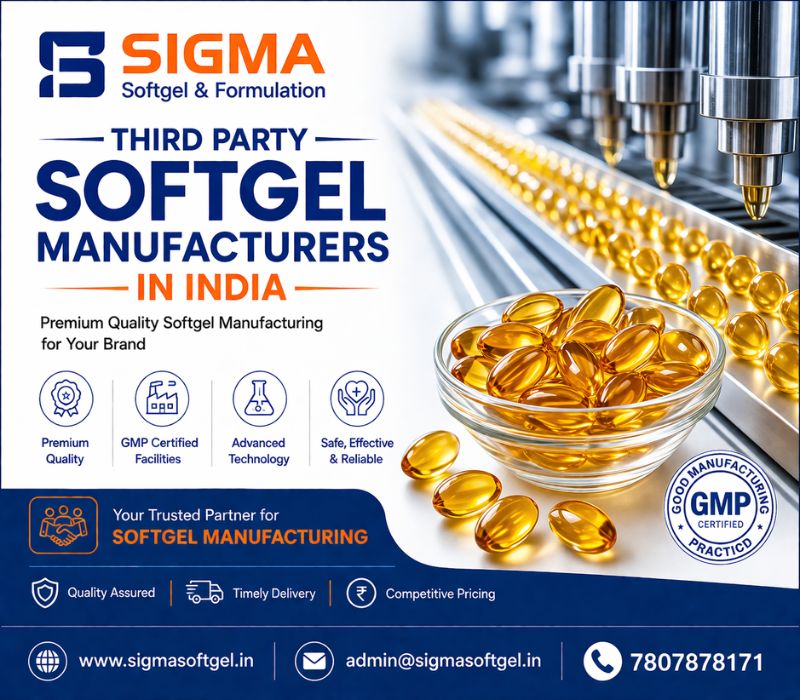
Third Party Softgel Manufacturers in India
The global pharmaceutical and nutraceutical industries have witnessed a monumental shift in delivery systems over the last decade. Among the various dosage forms, soft gelatin capsules—commonly known as softgels—have emerged as a gold standard for delivering oil-based formulations and poorly soluble active pharmaceutical ingredients (APIs). India, often hailed as the “Pharmacy of the World,” has become a primary hub for this technology. For businesses looking to scale, partnering with Third Party Softgel Manufacturers in India is no longer just a cost-saving measure; it is a strategic imperative for quality and innovation.
In this exhaustive guide, we explore the intricacies of the softgel market, the manufacturing process, regulatory milestones, and how to select the right partner to elevate your healthcare brand.
1. The Meteoric Rise of Softgel Capsules in India
The Indian pharmaceutical market is projected to reach significant heights by 2030. Interestingly, the sub-sector of softgel capsules is growing at an even faster clip. Why is this happening?
Historically, tablets and hard gelatin capsules dominated the market. However, as the focus shifted toward advanced nutrition—think Omega-3 fatty acids, Vitamin D3, and Coenzyme Q10—the limitations of traditional solids became apparent. Because these ingredients are lipophilic (fat-loving), they often become unstable when exposed to air or moisture.
Softgels provide an airtight, hermetically sealed environment that protects sensitive ingredients from oxidation. Furthermore, the Indian consumer’s growing preference for “easy-to-swallow” and “fast-acting” supplements has fueled a surge in demand. Consequently, local manufacturers are now meeting this need with world-class infrastructure.
2. What Exactly is Third Party Softgel Manufacturing?
Third-party manufacturing, often referred to as contract manufacturing or white labeling, is a business model where a brand (the client) outsources the entire production process to a specialized facility (the manufacturer).
In the context of softgels, this means the manufacturer handles the following tasks:
- Raw Material Sourcing: They procure high-bloom gelatin and pharmaceutical-grade oils.
- Formulation: Experts create the liquid or semi-solid fill material.
- Encapsulation: This technical process forms the shell and fills it simultaneously.
- Quality Control: Teams test for leaks, dissolution, and microbial purity.
- Packaging: The facility handles blister packing or bottling under the client’s brand name.
For a startup or an established pharma company, this model eliminates the need to invest millions in specialized rotary die encapsulation machines and climate-controlled drying rooms.
3. Key Benefits of Partnering with Third Party Manufacturers
A. Drastic Reduction in Capital Expenditure (CAPEX)
Setting up a softgel plant in India requires a massive investment in land, advanced machinery (like those from Changsung or Technophar), and specialized HVAC systems. By choosing a third-party partner, you can redirect your capital toward marketing, clinical trials, and distribution networks instead.
B. Access to Specialized Technical Expertise
Softgel manufacturing is more of an art than a science. The “gelatin ribbon” must have the perfect thickness, and the “injection wedge” temperature must be precise. Fortunately, Indian third-party manufacturers employ seasoned pharmacists who have mastered these variables over decades. As a result, they ensure that your product doesn’t leak or become brittle.
C. Scalability and Flexibility
Whether you need a pilot batch of 50,000 capsules for market testing or a commercial run of 5 million, third-party units provide the necessary scalability. This allows brands to manage inventory efficiently without the high cost of maintaining an idle factory during slow seasons.
D. Faster Time-to-Market
Building a factory and obtaining AYUSH or DCGI approvals can take years. In contrast, a third-party manufacturer already has the licenses and the production lines ready. Therefore, you can move from a concept to a finished, shelf-ready product in as little as 6 to 8 weeks.
4. The Softgel Manufacturing Process: A Technical Deep Dive
Understanding the process is vital for any brand owner. Generally, the production of softgels in India follows these five rigorous steps:
Step 1: Gelatin Mass Preparation
Operators mix gelatin powder with water and plasticizers (like glycerin or sorbitol) in a stainless steel melting tank. They heat and vacuum this “gel mass” to remove air bubbles. This step is crucial because air bubbles could cause capsules to burst later.
Step 2: Fill Material Preparation
While the gel is melting, the team prepares the “fill”—the active medicine or oil. If the fill is a suspension, they must homogenize it to ensure every single capsule contains the exact same dose.
Step 3: Encapsulation (The Rotary Die Process)
The machine spreads the gel mass over two rotating drums to form two flat ribbons. These ribbons pass between two rotating dies. As the dies meet, they cut out the capsule shape. Meanwhile, a pump simultaneously injects the fill material. The heat and pressure seal the edges instantly.
Step 4: Drying (The Critical Phase)
Freshly made softgels are “wet” and “soft.” First, workers place them in tumble dryers for initial moisture removal. After that, they move the capsules to drying tunnels. Since India has high humidity, manufacturers use sophisticated dehumidifiers to ensure the capsules reach the correct hardness.
Step 5: Inspection and Polishing
Finally, workers sort the capsules to remove “twins” or odd-shaped ones. They then polish the softgels to give them a characteristic pharmaceutical shine.
5. Regulatory Standards: Why India is Globally Trusted
India’s reputation in softgel manufacturing rests on its strict adherence to international and national standards. When you search for Third Party Softgel Manufacturers in India, always look for these certifications:
- WHO-GMP (Good Manufacturing Practices): This mandatory standard ensures the facility is clean, the processes are documented, and the staff is well-trained.
- ISO 9001:2015: This certificate focuses on quality management systems.
- FSSAI (Food Safety and Standards Authority of India): This is crucial if you are manufacturing nutraceuticals or health supplements.
- HACCP: This system ensures food safety through hazard analysis.
- DCGI (Drug Controller General of India): This is required for all pharmaceutical formulations.
For those interested in the official regulatory framework, the Central Drugs Standard Control Organization (CDSCO) provides the latest guidelines on manufacturing and licensing in India.
6. Popular Categories for Softgel Manufacturing
The versatility of this dosage form allows brands to use it across various segments:
I. Nutraceuticals and Dietary Supplements
Currently, this is the largest segment in India.
- Omega-3 and Fish Oils: These see high demand for cardiovascular health.
- Multivitamins: Manufacturers formulate these with fat-soluble vitamins like A, D3, E, and K.
- Herbal Oils: Common products include Garlic oil, Neem oil, and Evening Primrose oil.
II. Pharmaceutical Formulations
- Hormonal Preparations: Doctors widely prescribe progesterone softgels in gynecology.
- Pain Management: Ibuprofen softgels offer faster relief than traditional tablets.
- Anti-fungal: Manufacturers often put Itraconazole in softgels to improve its absorption.
III. Cosmeceuticals
- Hair and Skin Serums: Single-use “twist-off” softgels are now a popular luxury trend in the beauty industry.
7. How to Choose the Best Third-Party Partner in India
Not all manufacturers provide the same quality. To protect your brand, you should perform due diligence on the following factors:
- Infrastructure Audit: Check if the facility has automated encapsulation lines. Manual machines often lead to weight variation.
- In-house Testing Labs: Ensure they have a laboratory equipped with HPLC (High-Performance Liquid Chromatography).
- Moisture Control: Softgels are sensitive to heat. Therefore, check if they have dedicated drying rooms with climate logs.
- Transparency: A reliable partner always provides a “Certificate of Analysis” (COA) for every batch.
- Track Record: Review their client list. If they manufacture for top Indian pharma giants, they likely maintain high standards.
8. Current Trends Shaping the Industry in 2025
A. Vegetarian Softgels (Vegicaps)
With a large vegetarian population in India and a global “vegan” movement, manufacturers are moving away from animal-based gelatin. Instead, they use starch and carrageenan-based shells. These shells are more stable at higher temperatures, which makes them ideal for the Indian climate.
B. Enteric Coated Softgels
To prevent the “fishy burp” associated with Omega-3, manufacturers apply enteric coatings. These coatings ensure the capsule passes through the stomach safely and only dissolves in the intestine.
C. Chewable Softgels
Manufacturers often design these for pediatric supplements. They have a specialized shell that the child can chew to release a flavored liquid inside.
9. Challenges in Softgel Manufacturing
While the benefits are many, the process involves several hurdles:
- Ingredient Compatibility: Not all liquids work in a softgel. For instance, liquids with high water content will dissolve the shell from the inside.
- Cross-Linking: Certain ingredients can cause the shell to become insoluble over time.
- Supply Chain Issues: Fluctuations in the price of high-quality gelatin can affect your production costs.
10. The Economic Impact: India as an Export Hub
Third-party softgel manufacturers in India do more than just serve the domestic market. In fact, they export a significant portion of their production to the USA, Europe, and Africa. Because India combines low labor costs with high technical compliance, Indian softgels are often 30-40% cheaper than those produced in the West.
11. Conclusion: Building Your Brand with the Right Foundation
The journey of launching a healthcare brand presents many challenges, but manufacturing should not be one of them. By leveraging the expertise of Third Party Softgel Manufacturers in India, you gain access to a world-class production ecosystem. This system prioritizes safety, stability, and consumer trust.
As the industry moves toward specialized nutrition, the softgel capsule remains the most reliable delivery method. Whether you are launching a simple multivitamin or a complex drug, the right third-party partner will provide the technical support your brand needs to succeed globally.
Frequently Asked Questions (FAQs)
Q1: What is the Minimum Order Quantity (MOQ) for softgel manufacturing in India? MOQs typically range from 50,000 to 100,000 capsules per batch. However, this depends on the complexity of your formula.
Q2: Can I provide my own raw materials to the manufacturer? Yes, many units offer “job work.” In this arrangement, you provide the active ingredients, and the manufacturer charges only for encapsulation and packaging.
Q3: How do I verify the quality of a softgel batch? You should always check the “Disintegration Time” and the “Weight Variation” records. A professional manufacturer will include these in the batch records.
Q4: Are there different shapes available for softgels? Absolutely. Manufacturers offer various dies including Oval, Oblong, and Round shapes in many different colors.
 Home
Home Ask For Rate
 Call Us
 Whatsapp